 Trip-Pups
OpenD-1Hosted by TripPups
Dobong Hangeul History Walk
Sat 14 Nov, 2-4pm
Meet at the ginkgo tree at Wondangsaem, Banghak-dong. No Korean needed: we interpret.
How to get here
- Easiest: Ssangmun Station (Line 4) exit 2, then bus 130. tour.dobong.go.kr
- Bus 130 stops in the middle of the road, 3 minutes from the exit. Get off after 8 stops at Yeonsangun·Jeongui Gongju Myo (연산군.정의공주묘) and walk 3 minutes. About 22 minutes in all, by Kakao Map. map.kakao.com
- From Banghak Station (Line 1), walking takes 40 minutes. Take bus 1167 from the Banghak Station North stop (5 minutes' walk), 7 stops to the same stop. About 19 minutes in all, by Kakao Map. map.kakao.com
- A CU convenience store is 4 minutes' walk from the ginkgo tree, for water or an umbrella. place.map.kakao.com
Taxi? Show this to the driver.
방학동 은행나무 원당샘으로 가 주세요
Banghak-dong eunhaeng-namu Wondangsaem-euro ga juseyo
Please take me to the Banghak-dong ginkgo tree at Wondangsaem.
Restrooms
- Right by Wondangsaem Park, the Wondang Village Hanok Library (원당마을한옥도서관) has a restroom open to the public. We haven't checked its hours. place.map.kakao.com
- At Ssangmun Station, the restrooms are inside the ticket gates. place.map.kakao.com
Starts at 2pm
At the old ginkgo tree, Wondangsaem
Lost? Show this to someone nearby.
방학동 은행나무가 어디예요?
Banghak-dong eunhaengnamu-ga eodiyeyo?
Where is the Banghak-dong ginkgo tree?
How to get here
- Easiest: Ssangmun Station (Line 4) exit 2, then bus 130. tour.dobong.go.kr
- Bus 130 stops in the middle of the road, 3 minutes from the exit. Get off after 8 stops at Yeonsangun·Jeongui Gongju Myo (연산군.정의공주묘) and walk 3 minutes. About 22 minutes in all, by Kakao Map. map.kakao.com
- From Banghak Station (Line 1), walking takes 40 minutes. Take bus 1167 from the Banghak Station North stop (5 minutes' walk), 7 stops to the same stop. About 19 minutes in all, by Kakao Map. map.kakao.com
- A CU convenience store is 4 minutes' walk from the ginkgo tree, for water or an umbrella. place.map.kakao.com
Taxi? Show this to the driver.
방학동 은행나무 원당샘으로 가 주세요
Banghak-dong eunhaeng-namu Wondangsaem-euro ga juseyo
Please take me to the Banghak-dong ginkgo tree at Wondangsaem.
Restrooms
- Right by Wondangsaem Park, the Wondang Village Hanok Library (원당마을한옥도서관) has a restroom open to the public. We haven't checked its hours. place.map.kakao.com
- At Ssangmun Station, the restrooms are inside the ticket gates. place.map.kakao.com
On the walk
Tap the stop you're at. Then tap Listen, or open the words the guide will say.
 1Banghak-dong Ginkgo Tree
 2Tomb of King Yeonsangun
 3Kim Su-young Literary Museum
 4Tomb of Princess Jeongui
 5Gansong's Old House
Restrooms
- Right by Wondangsaem Park, the Wondang Village Hanok Library (원당마을한옥도서관) has a restroom open to the public. We haven't checked its hours. place.map.kakao.com
- At Ssangmun Station, the restrooms are inside the ticket gates. place.map.kakao.com
Walk finished
Thanks for walking with us.
Getting home
- Dobong-gu's Route 1 ends at Gansong's old house, 149-18 Sirubong-ro. kansonghouse.kr
- To Ssangmun Station (Line 4): walk 7 minutes to the Banghak-dong Sindonga Tower stop, then bus 130. About 24 minutes in all, by Kakao Map. map.kakao.com
- To Banghak Station (Line 1): 31 minutes on foot, or bus 1167 from the Sinbanghak Middle School stop, about 16 minutes in all, by Kakao Map. map.kakao.com
Signed up for the International Gathering (4:30-6pm)? We go together on bus 1167 from the Sinbanghak Middle School stop to Banghak Station, about 20 minutes. The café's address goes to people who signed up.
Next with TripPups
Thanks for walking with us
Here's what's next.
Next with TripPups
4 of 10 spots left · Sign up by Sat 14 Nov, 12pm
무엇이든 물어보세요
Ask the Dobong guide in your language
Five stops
-
1 / 5
Stop 1 of 5
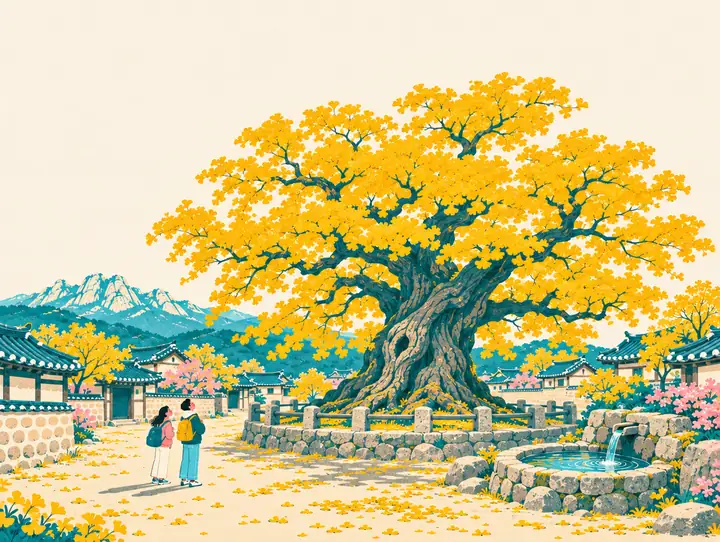
Banghak-dong Ginkgo Tree and Wondangsaem Spring
방학동 은행나무 · 원당샘
The start
Words the guide will say · 5
Tap a word to hear it- 은행나무 eunhaengnamuginkgo tree
- 원당샘 WondangsaemWondang Spring (샘 means spring)
- 보호수 bohosuprotected tree
- 수령 suryeonga tree's age
- 자연유산 jayeonyusannatural heritage
Read along
Chapter 1. The start. Hangeul was made in 1443. This tree is about 550 years old, give or take 50, so the two are roughly the same age.[1]
This ginkgo tree is a protected natural heritage of Seoul.[1] Scientists from the National Institute of Forest Science measured its age at about 550 years, give or take 50.[1] In 1968 it became Seoul's first protected tree.[2] An old local story says that whenever this tree caught fire, something bad happened to the country.[2]
Look forLook at the spring next to the tree. The village drank from Wondangsaem for hundreds of years.[3]
Sources: [1] heritage.go.kr [2] tour.dobong.go.kr [3] tour.dobong.go.kr · checked 2026-11-05 · Picture: illustration, not a photo
-
2 / 5
Stop 2 of 5
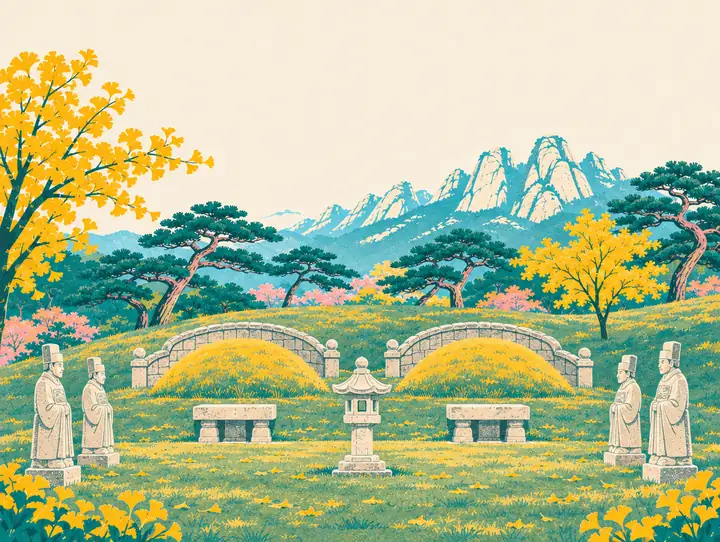
Tomb of King Yeonsangun
연산군묘
The ban
Words the guide will say · 7
Tap a word to hear it- 연산군 YeonsangunKing Yeonsan. The ending -gun is a prince's title, not a king's
- 묘 myograve
- 능 neungroyal tomb
- 폐위 pyewiremoved from the throne
- 사화 sahwaa purge of scholar-officials
- 반정 banjeongoverthrowing a king to put another on the throne
- 언문 eonmunan old everyday name for Hangeul
Read along
Chapter 2. The ban. In July 1504, after posters mocked him, this king banned using, learning and teaching Hangeul, about 60 years after it was made. The total ban ended five months later.[3]
This is the grave of Yeonsangun, the 10th king of the Joseon dynasty (ruled 1494-1506), and his wife, Lady Shin.[1] He had many scholars killed and was pushed off the throne in 1506.[1] He died in exile on Ganghwa Island that year, and in 1512 his wife asked to move his grave here.[1] He lost the title of king, so his grave is called a myo (grave), not a neung (royal tomb).[2]
Look forTwo mounds sit side by side. From the front, Yeonsangun is on the left and his wife is on the right.[1]
Free. Nov-Feb 9:00-17:30. Closed Mondays.[2]
Sources: [1] heritage.go.kr [2] tour.dobong.go.kr [3] en.wikipedia.org · checked 2026-11-05 · Picture: illustration, not a photo
-
3 / 5
Stop 3 of 5
Kim Su-young Literary Museum
김수영문학관
What you can say
Words the guide will say · 6
Tap a word to hear it- 시인 siinpoet
- 문학관 munhakgwanliterary museum
- 풀 pulgrass, the title of his last poem
- 자유 jayufreedom
- 포로수용소 porosuyongsoprisoner-of-war camp
- 사일구 혁명 sailgu hyeongmyeongthe April 19 Revolution of 1960, written 4·19
Read along
Chapter 3. What you can say. By the time of Kim Su-young's poems the question was no longer the letters but what you may say with them. The museum sets his poems beside the Korean War and the April 19 Revolution.[2]
Kim Su-young (1921-1968) is one of Korea's best-known modern poets, and he wrote about freedom and love.[1] In the Korean War he was held in a prisoner-of-war camp, and that time shaped how he thought about freedom.[1] His last poem, Grass (풀), is his best-known work.[1] His family home, his grave and a stone with his poem are in Dobong-gu, so the district opened this museum in 2013.[2]
Look forOn the first floor, his poems sit next to big events he lived through, like the Korean War and the April 19 Revolution.[2]
Free. 9:00-18:00. Closed Mondays.[3]
Sources: [1] kimsuyoung.dobong.go.kr [2] kimsuyoung.dobong.go.kr [3] kimsuyoung.dobong.go.kr · checked 2026-11-05 · Picture: illustration, not a photo
-
4 / 5Photo time: write your name in Hangeul
Stop 4 of 5
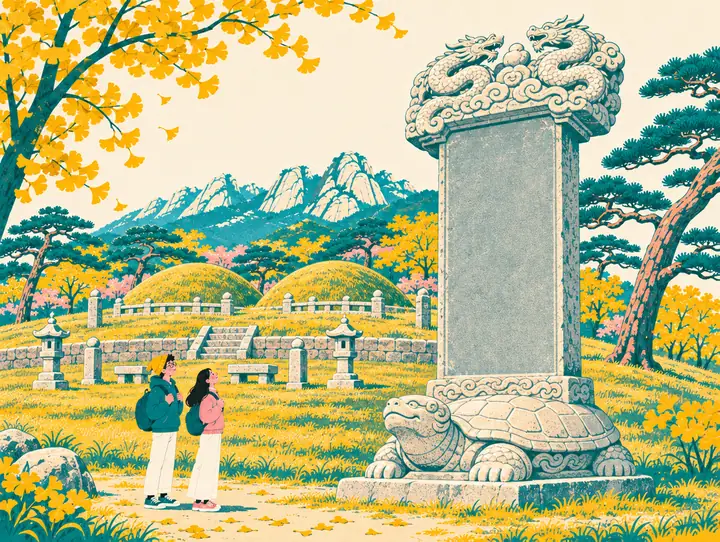
Tomb of Princess Jeongui and An Maeng-dam
양효공 안맹담과 정의공주 묘역
Back to the beginning
Words the guide will say · 6
Tap a word to hear it- 세종대왕 Sejong daewangKing Sejong the Great
- 공주 gongjuprincess, a king's daughter by the queen
- 훈민정음 Hunminjeongeumthe first name of Hangeul
- 부마 bumaa king's son-in-law
- 신도비 sindobia stone tablet about a person's life, set by the path to the grave
- 묘역 myoyeokgrave site
Read along
Chapter 4. Back to the beginning. Dobong-gu calls Princess Jeongui a hidden flower of the creation of Hangeul. Her husband's family records say she helped King Sejong with hard sound problems. That is a family story, not proven history.[3]
Princess Jeongui was the second daughter of King Sejong.[1] She was known as very bright, and she understood calendars and math well.[1] Her husband's family records say she helped King Sejong solve hard sound problems while he made Hangeul, but this is a family story, not proven history.[2] She lies here with her husband, An Maeng-dam, with his grave on the west side and hers on the east.[1]
Look forFind the tall stone tablet from 1466. It stands on a stone turtle and has two dragons carved on top.[1]
Sources: [1] heritage.go.kr [2] encykorea.aks.ac.kr [3] tour.dobong.go.kr · checked 2026-11-05 · Picture: illustration, not a photo
-
5 / 5
Stop 5 of 5
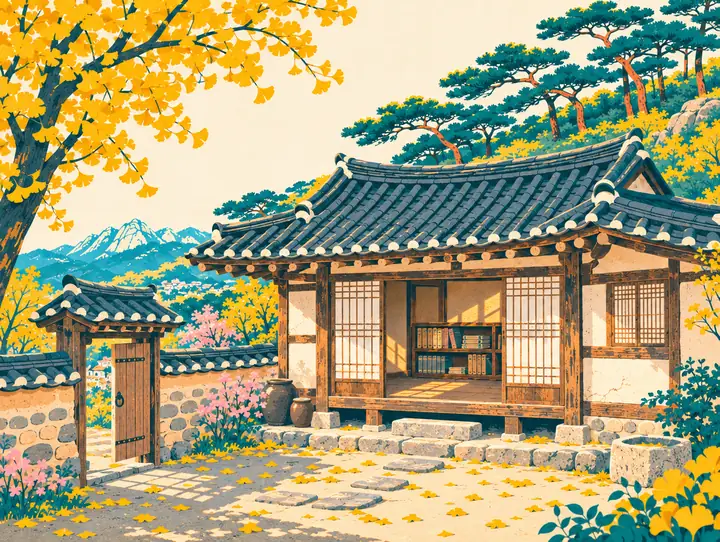
Gansong's Old House (Jeon Hyeong-pil House)
간송옛집 (서울 방학동 전형필 가옥)
The manual
Words the guide will say · 7
Tap a word to hear it- 간송 GansongJeon Hyeong-pil's pen name
- 호 hopen name
- 옛집 yetjipold house
- 한옥 hanoktraditional Korean house
- 해례본 haeryebonthe edition with explanations and examples
- 국보 gukboNational Treasure
- 일제강점기 iljegangjeomgithe Japanese colonial period
Read along
Chapter 5. The manual. The book explaining how Hangeul was designed was unknown until it turned up around 1940, under Japanese rule. Jeon Hyeong-pil paid more than a house was worth for it and kept it in a paulownia box through colonial repression and the Korean War. It belongs to his Kansong museum in Seongbuk-gu, across Seoul from this house. Hangeul Day, 9 October, comes from the date written at the end of that book.[4]
Jeon Hyeong-pil (1906-1962), known as Gansong, collected Korean art and old books during Japanese colonial rule.[1] He kept Korean treasures from being taken away, and he brought back pieces that had left Korea.[2] In 1938 he built Bohwagak, Korea's first private museum, now the Kansong Art Museum.[1] The 1446 book that explains how Hangeul works, the Hunminjeongeum Haerye, was found around 1940 and became part of his collection. It is now a National Treasure and on UNESCO's Memory of the World list.[3]
Look forLook at the house itself: a traditional hanok over 100 years old.[2]
Sources: [1] encykorea.aks.ac.kr [2] heritage.go.kr [3] encykorea.aks.ac.kr [4] hangyo.com · checked 2026-11-05 · Picture: illustration, not a photo
Good to know
Easiest way: Ssangmun Station (Line 4) exit 2, then bus 130 to the Yeonsangun·Jeongui Gongju Myo stop. From Banghak Station (Line 1) take bus 1167 to the same stop: walking from Banghak Station takes about 40 minutes.
- Free. Come alone. No Korean needed: we interpret.
- Please don't film the guide.
WhatsApp group · hi@trip-pups.com
About this walk
Dobong Cultural Center (도봉문화원) runs guided heritage walks called Saturday Dobong Walks (토요탐방 도봉기행). A cultural guide walks with the group and explains each place in Korean.[1] The center offers seven routes. This walk is Route 1, the Hangeul History and Culture Walk.[1] Dobong-gu's map of Route 1 lists seven points in order: Wondangsaem Park, the Banghak-dong ginkgo tree, Yeonsangun's tomb, the Kim Su-young Literary Museum, the tomb of An Maeng-dam and Princess Jeongui, the tomb of Mok Seo-heum, and Gansong's old house.[2] Dobong-gu describes Princess Jeongui as a hidden flower of the making of Hangeul.[2]
Dobong-gu calls this route the Hangeul History and Culture Walk (한글역사문화길). Dobong-gu
Dobong guide도봉 해설 친구Ask the guide
An AI answers from the facts on this page only. If it doesn't know, ask your host in the group chat. Questions are not saved.
 Selected for Modoo Startup 2026Office: Sadari Lab, Sogang University · 35 Baekbeom-ro, Mapo-gu, Seoul
Contact us · Privacy · Terms